Centro de Arte Juan Ismael · Fuerteventura · Spain
MAY, 26. 2026 – AUG, 14. 2026
organizes_
Centro de Arte Juan Ismael (CAJI)
curator Alejandro Gopar
Production and coordination Galería Artizar
Alejandro Gopar
Let’s begin, albeit slowly, for our ultimate destination is ourselves.
With the caution of someone who has just fallen, without realising which scars led to their fall and which new wounds will now accompany them. That process often casts a shadow; it makes us wary and creates a void in which vertigo no longer has a vertical dimension and instead encroaches upon the very fabric of existence. There are times when what once seemed to be solid and stable ceases to be so and forces us to reconsider not only where we are heading, but also where we have been.
How often does an accident change everything in an instant? The course seemed clear, but the destination, as always, remained uncertain. Perhaps that is the most romantic aspect of our journey. All it takes is a single wave, a stroke of bad luck, and everything is thrown into turmoil. And then, all of a sudden, you have no choice but to learn.
The realisation that you don’t know something is both painful and, at the same time, stimulating. There is a fascinating contradiction in this: a void opens up within your being which, at the same time, you long to find. That void could be seen just as a loss, but it can also become the space through which transformation begins. Coming across a path as yet untravelled brings with it uncertainty about a horizon we cannot yet make out. Caught between the desire for freedom and the need to recognise new boundaries. Because the absence of boundaries is not necessarily freedom. Being always entails certain forms, and perhaps it is precisely in the process of giving shape to these forms that we discover how far we want to go and when.
We need to investigate these forms. Not because the self should be confined by them, but because it is precisely within that realm that the energy of art can interfere with a reality that does not quite align with the truth of each and every one of us. Art thus appears as an endless exploration: a way of producing images, bodies, spaces and representations capable of challenging what we thought we knew. Investigating a form also involves asking what forces have produced it, what sustains it, what distorts it, and what possibilities emerge when it no longer lives up to our expectations of it.
This tension also extends to the concept of the collective. Collective projects have long been driving forces behind thought and the arts. “Strength in unity” seems to point to a shared direction, but strength is, in reality, made up of distinct vectors that do not always share the same dimension. If the direction, time, space and intensity of the experience do not coincide in exactly the same way for every person, perhaps we need to rethink what we mean by ‘the collective’. Perhaps what it means to be united is not about erasing our differences to create a single form, but about finding a place where those differences can coexist whilst remaining unchanged.
It is precisely at this point of tension between the individual and the collective that Romina Rivero’s research is situated. Her practice stems from a personal experience of rupture that shattered one way of being and, at the same time, awakened a new consciousness. A force came crashing into her life, leaving both visible and invisible wounds. Some could be diagnosed as physical ailments; others, more complex, remained beyond any precise diagnosis, despite the immense pain they caused. That event left a void, a fissure through which a different way of growing began to take shape.
There are some things that defy language. Feelings that are hard to express, to put into words. Sometimes we experience moments of such intensity that perhaps the ticking of our hearts should be read as Morse code, and the surface of our skin — our entire skin — as the trembling script of an ancient codex written on parchment. The body retains what language sometimes fails to capture. It becomes an archive, a surface for inscription, but also a place from which it is possible to listen.
However accurate a diagnosis may be, there is always something more: something unique, almost indescribable. That pain wasn’t there simply to be observed or diagnosed. Had it appeared in response to a void? Perhaps as a kind of formal representation of an inner wound. A deep wound that needs a change of scenery to heal. It was then that another idea of healing emerged: not one of erasing suffering or returning to a previous state, but of learning to look beyond it and to heed the small yet transformative lessons it may hold. Thus, healing begins as a form of listening.
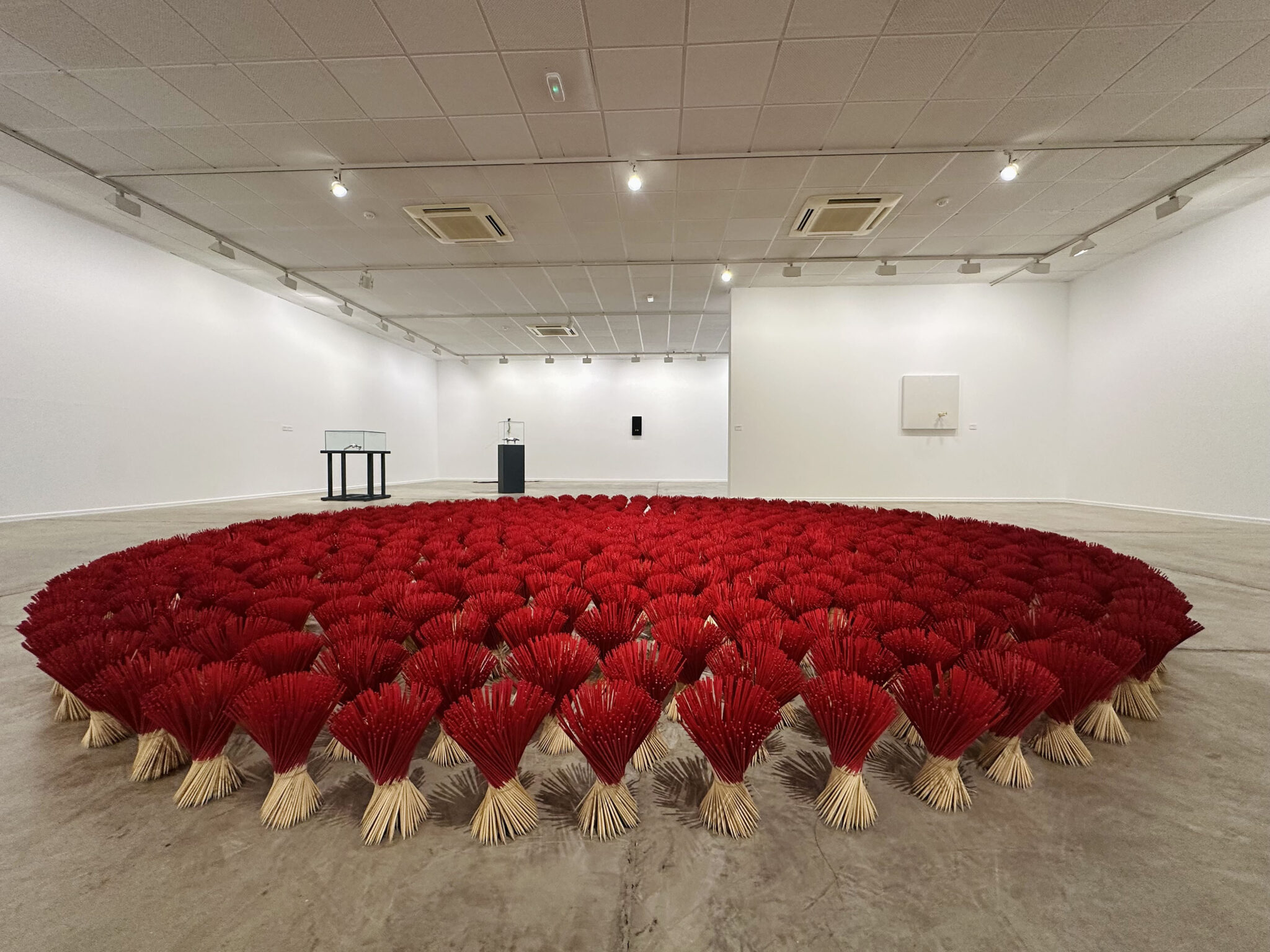
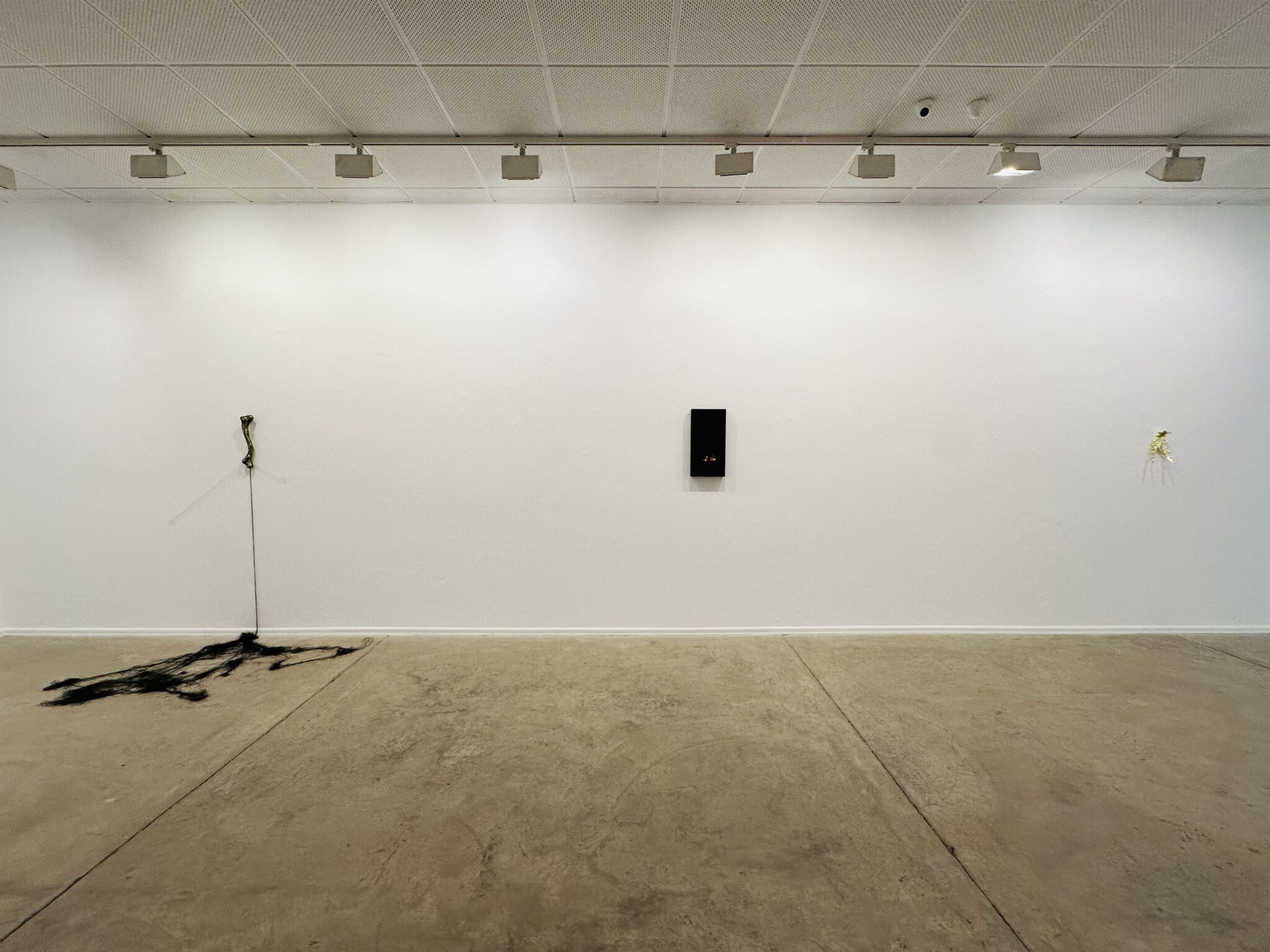
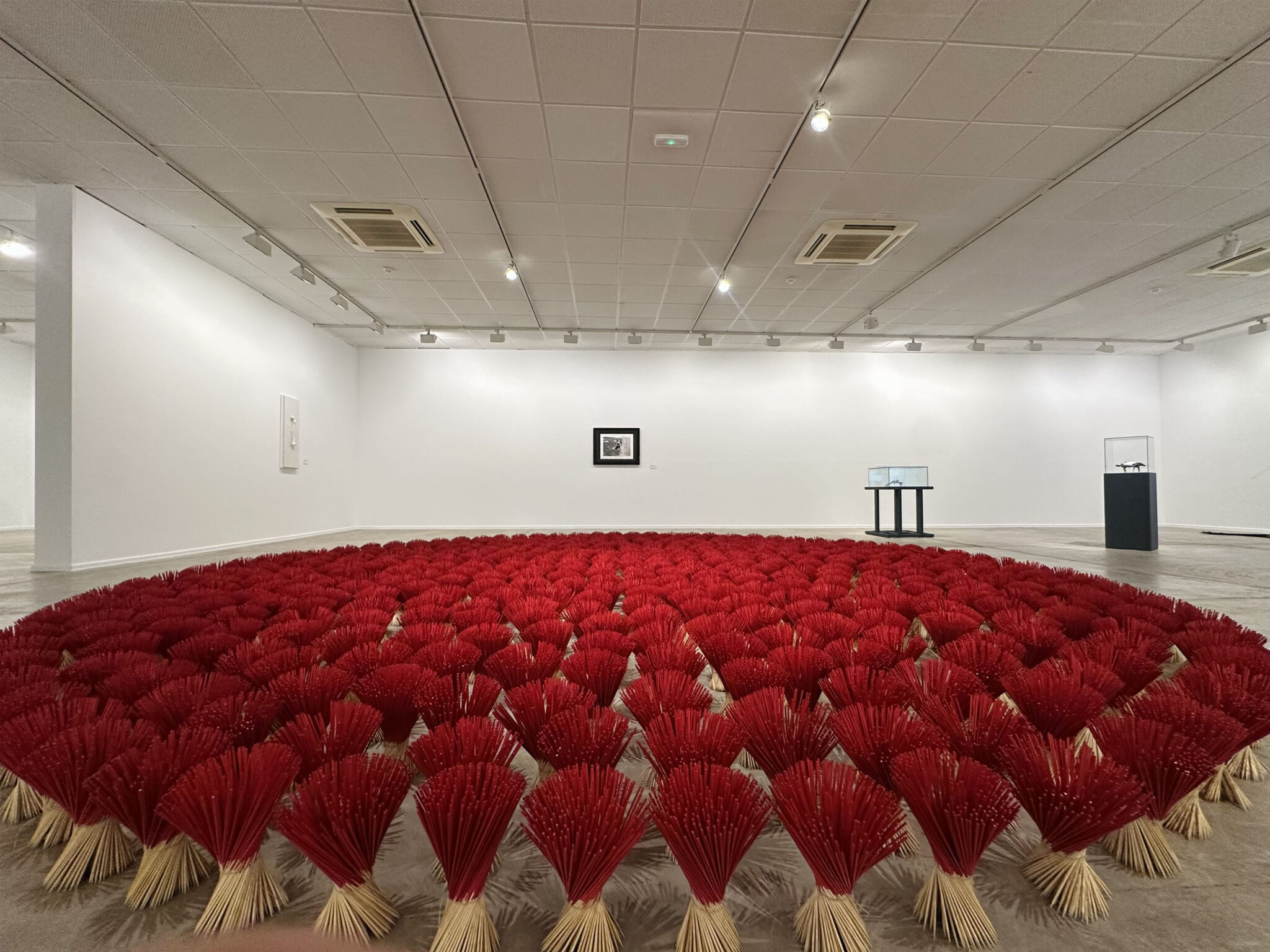
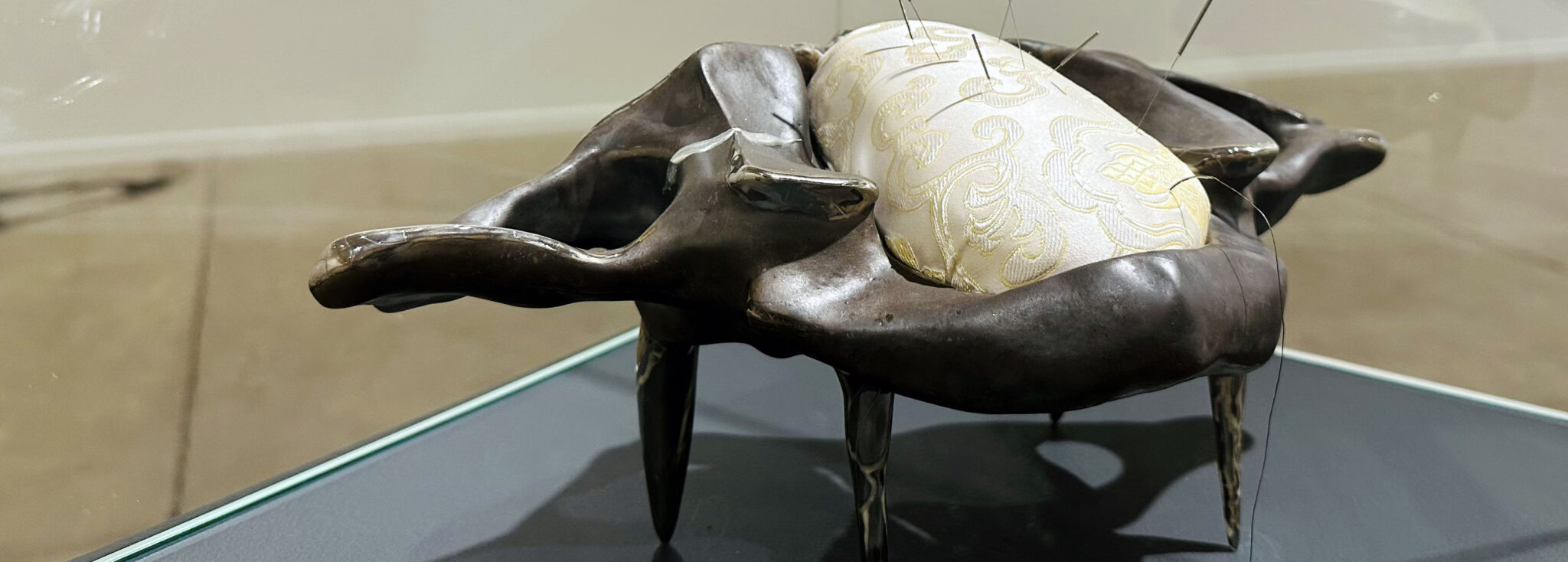
The exhibition Suture. Letting the light in can be understood in terms of this shift: from falling to listening, from fracture to the possibility of transformation. Even the spatial layout creates a sense of movement. On the lower floor, a circular arrangement of bundles of red incense sticks links and divides two groups of artworks: on one side, dark tones and black; on the other, the presence of white. Incense introduces a different dimension: its very nature suggests impermanence; it burns away, transforms and disappears while leaving a trace in the space. The hint of its smoke creates a presence that cannot be fully defined, an element that lies somewhere between the visible and the invisible, between the body and the air. The colour red intensifies this presence and can be interpreted as a sign of energy, of injury, of life and of movement. This incense ‘roundabout’, therefore, functions not merely as a physical separation between two areas of the exhibition, but as a liminal space, a place of transition where opposites — darkness and light, contraction and openness, body and consciousness — can coexist without being reduced to a rigid opposition. In this sense, the arrangement may evoke the dynamic relationship between yin and yang, understood not as a division between absolute opposites, but as a continuous movement between complementary forces. As we move around this floor, we are treated to an experience in which matter, space and the body all undergo the same transformation.
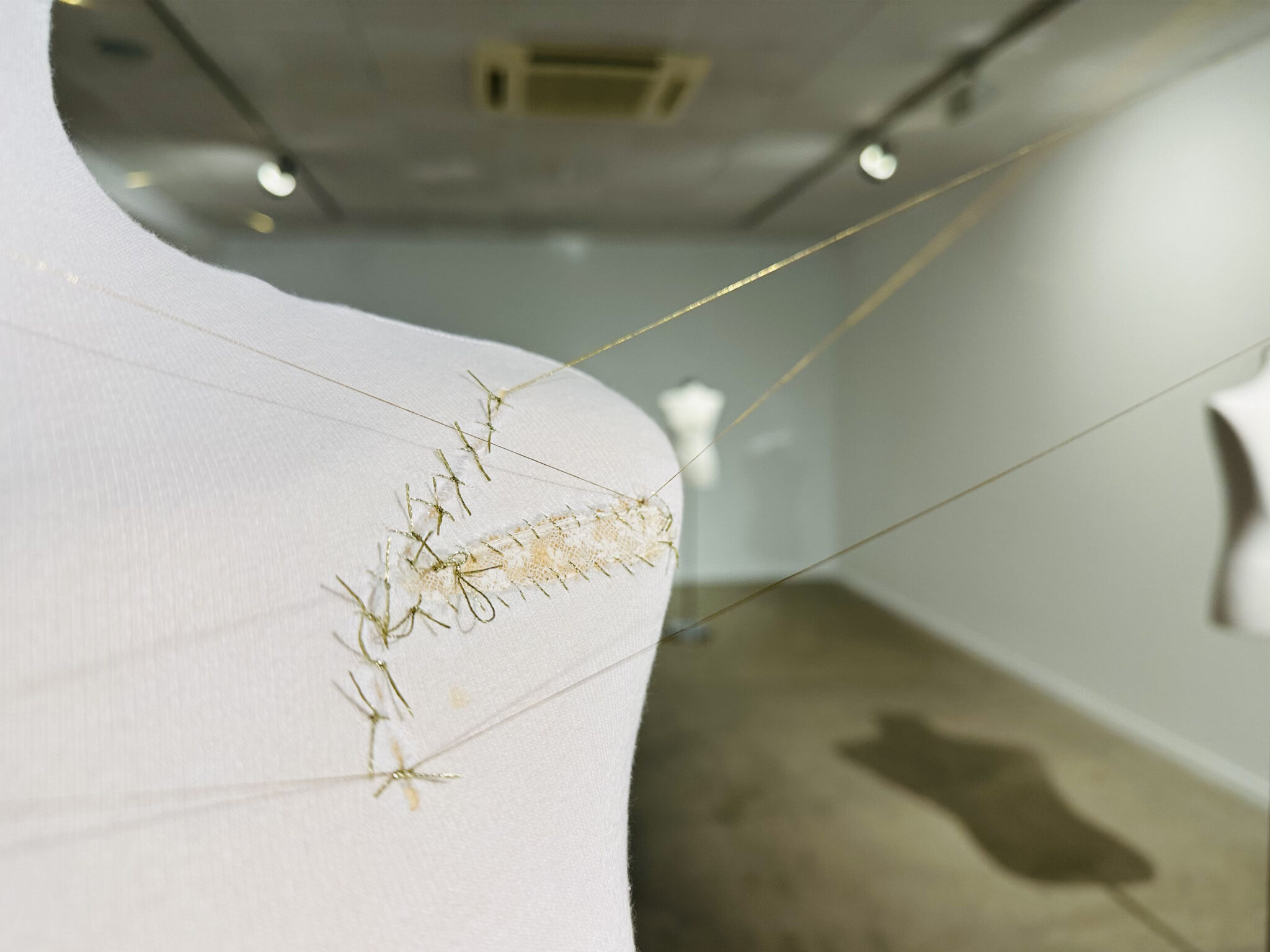
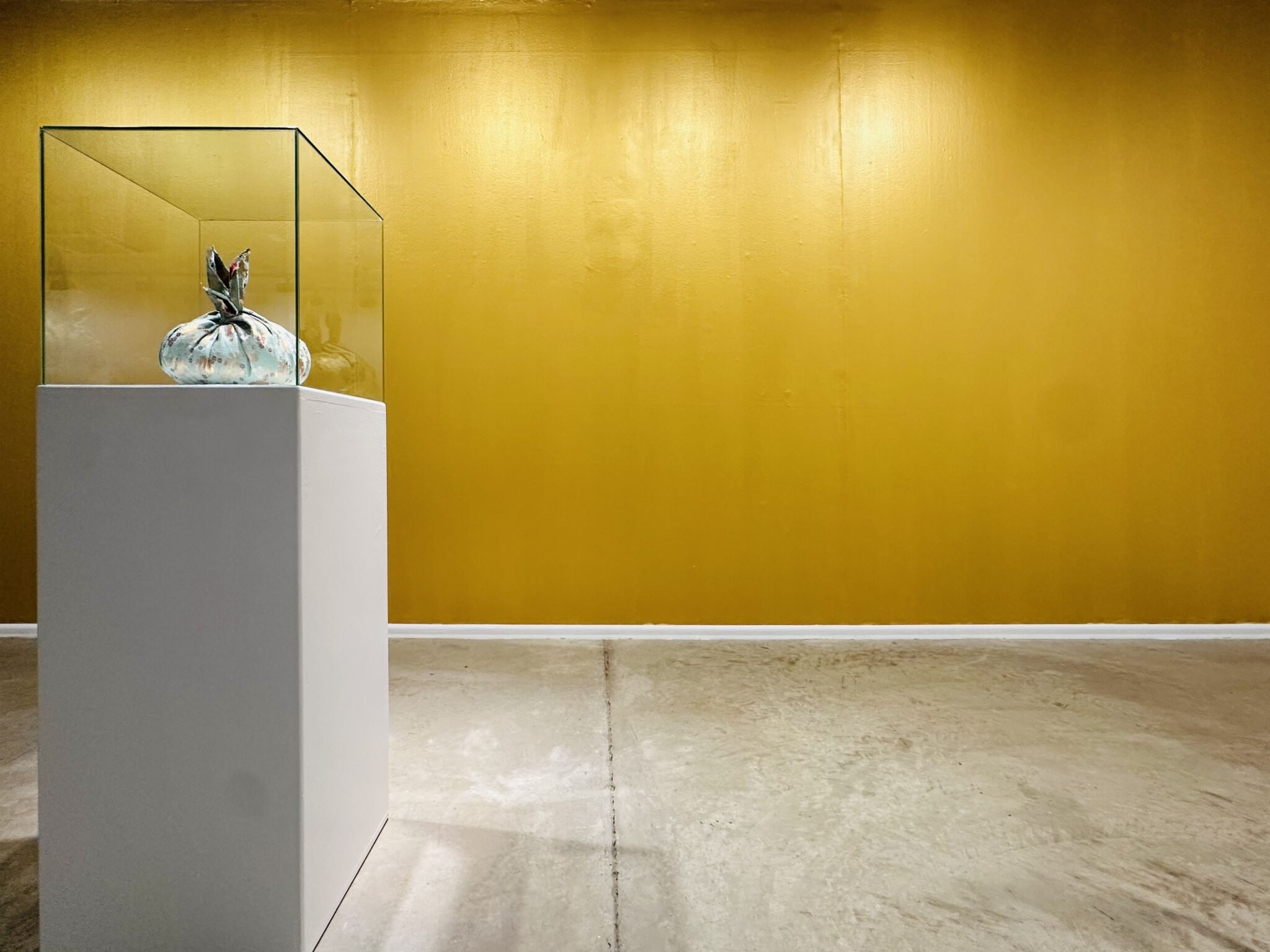
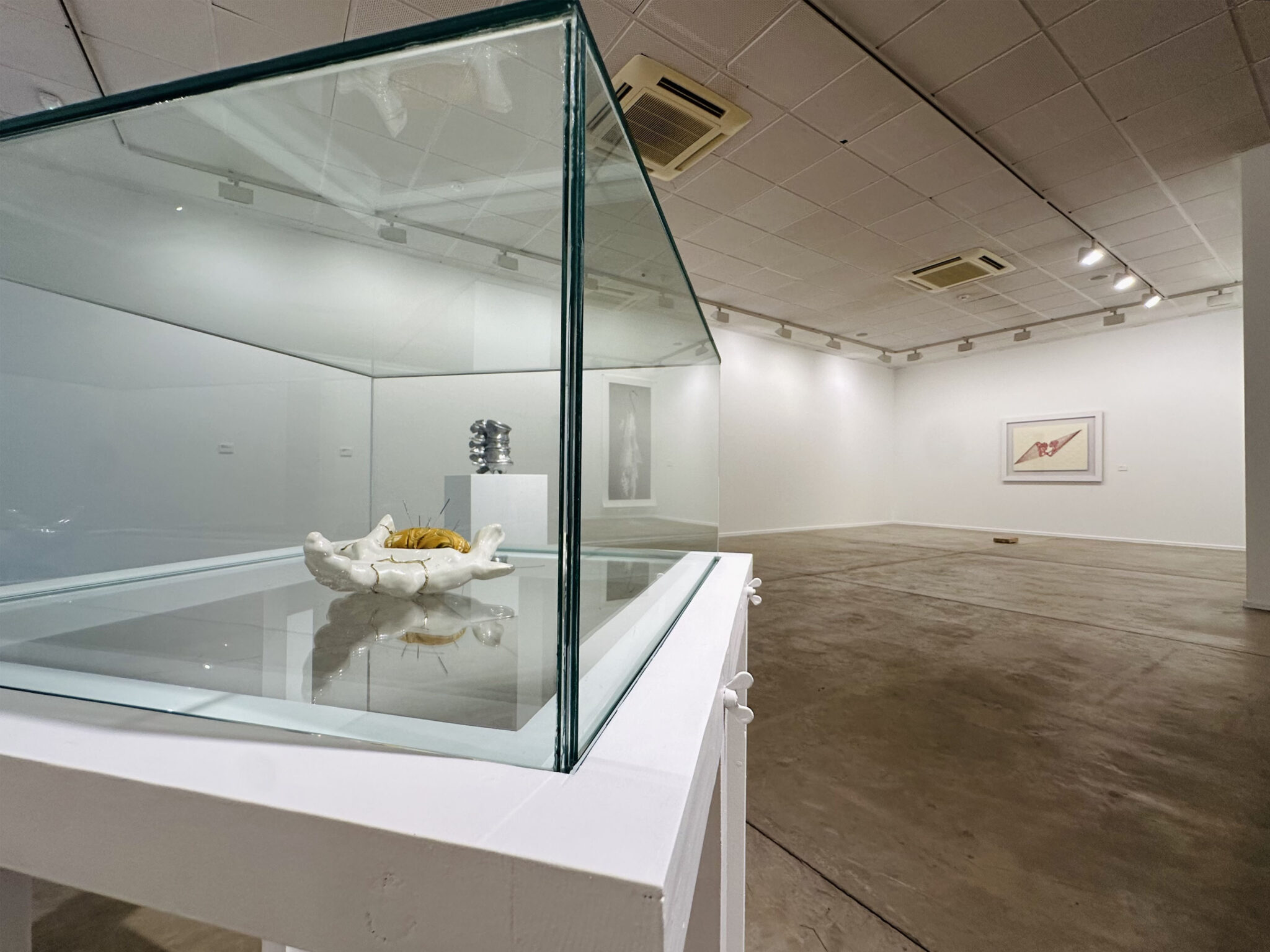
On the upper floor, we move towards the suture, kintsugi and growth. While below we find a realm characterised by the tension between forces and by the presence of incense as a substance undergoing transformation, above, the possibility of healing, uniting and growing becomes more clearly apparent. But repairing does not mean restoring. Suturing does not necessarily restore the body to its previous state: it joins, supports and creates a new continuity out of discontinuity. Similarly, kintsugi does not seek to conceal an object’s breakage, but rather to incorporate that breakage into its history. The scar is no longer something that must disappear and instead becomes part of the form that now exists.
In this process, the body emerges as a realm of knowledge. The spine is particularly significant because it allows us to conceive of the body as both a structure and, at the same time, an axis. According to certain interpretations of the I Ching and traditional Chinese medicine, the spine can be understood symbolically as an axis between Heaven and Earth: the head open to the spirit, the sacrum rooted in the earth, and the spine as a channel through which the forces that sustain and transform existence flow. Each vertebra can therefore be seen as a segment of life, a point of support, a phase, a decision.
The body thus becomes a living I Ching: a realm where each segment can signify a transformation and where the interplay between opposing forces does not necessarily imply conflict, but rather continuity. Qi, understood as the flow of life force, allows us to envisage this movement as a current that flows through the body and keeps it in harmony with itself. Healing, therefore, would not mean erasing the wound, but rather recognising the continuity between that which has broken us and the strength that arises as we find our centre once more.
It is there that the central theme of the learning process Romina has been weaving together for years takes shape: learning to stitch up each of the rifts that, long ago, fragmented her being and turned her power into a hindrance. That unfortunate blow altered the current through which she flowed, but it also opened up the possibility of a different state of consciousness. What might initially have been seen as a loss eventually became a source of knowledge. Not because pain necessarily holds a lesson, but because Romina chose to listen to what her own experience was demanding she learn.
Suture explores that process. It does not depict a story of overcoming adversity, nor does it seek to offer a definitive answer to the experience of pain. Rather, it brings to light an ongoing investigation: the search for forms capable of containing that which breaks, that which changes and that which we cannot yet name. Here, suturing is a material, physical and symbolic act. It brings two parts together, but also serves as a record of the fact that they were once separate. Its purpose isn’t to deny the wound, but to allow the body to continue.
In this way, the practice aligns with the concept of self-healing, understood as the construction of identity. While Louise Bourgeois found in self-construction a way to strengthen and reconstruct her identity, Romina Rivero approaches her own identity as a realm of self-healing: a space in which identity is not a fixed form, but something that is transformed as it passes through the experiences that shape it. Her research also aligns with the legacy of other women artists, researchers, doctors and teachers who have worked through the lens of the body, care and knowledge, many of whom have been silenced or have remained largely invisible throughout history.
That is why Sutura does not simply suggest looking at a wound. It invites us to take a moment to reflect on what is happening around that wound. On the energy that flows through it, the forms that break apart, the forces that bring them back together, and the awareness that arises during that process. The exhibition begins with the fall, moves through the fracture and finds a kind of continuity in the suture. Light is able to enter not because the darkness disappears, but because we learn to recognise that both are part of the same journey.
Art does not impose itself: it opens up. Like a wound that learns to speak, like a body that remembers. Like a form which, having been shattered, discovers that it too can be transformed.
And on that threshold, perhaps, our own journey also begins.