It’s becoming clear that painting in the 21st century is an act of resistance and religiosity. It might not be discussed in this latter term, however, because for us Westerners, religiosity refers exclusively to our Judeo-Christian heritage, and it is precisely this legacy that has been in crisis since the rise of imperialism, operating as a dominant system in constant decline, perhaps due to the original deviation from its very essence. In other words, because faith has become institutionalised as a tool of control wielded by the de facto powers of the State and the churches, and because those who embrace such religiosity come off as corrupt, false, and with an imperial stench that reaches down to their very foundations. Yet there is something religious – or perhaps, to be more precise, ‘something monastic’, priestly – in the act of painting in this century of images celebrated for their technological advances; the century that brought to fruition the dehumanised critical warning issued by Walter Benjamin in his prescient essay: The Work of Art in the Age of Mechanical Reproduction, in which he warned us of the potential ‘death of art’ (as we knew it in the 20th century) amidst the decline of its ‘aura’; since the auratic quality fades when reproduced. For this reason, painting – which, incidentally, a robot has been shown to be capable of doing, though it never turns out quite the same as when done by human hand – remains an activity that encapsulates an enduring ‘measure of faith’ in humanity.
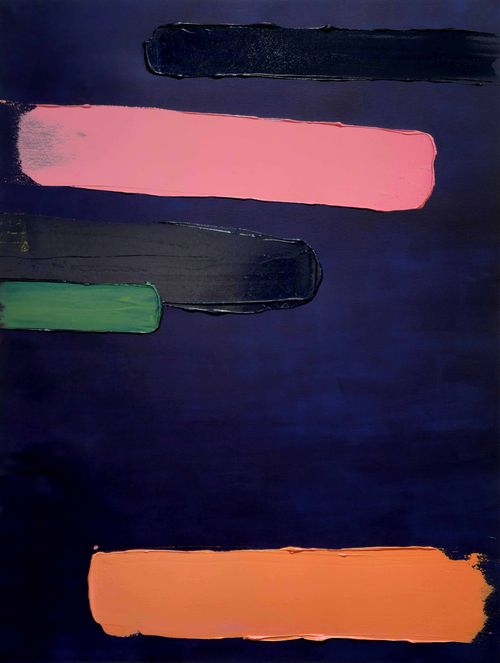
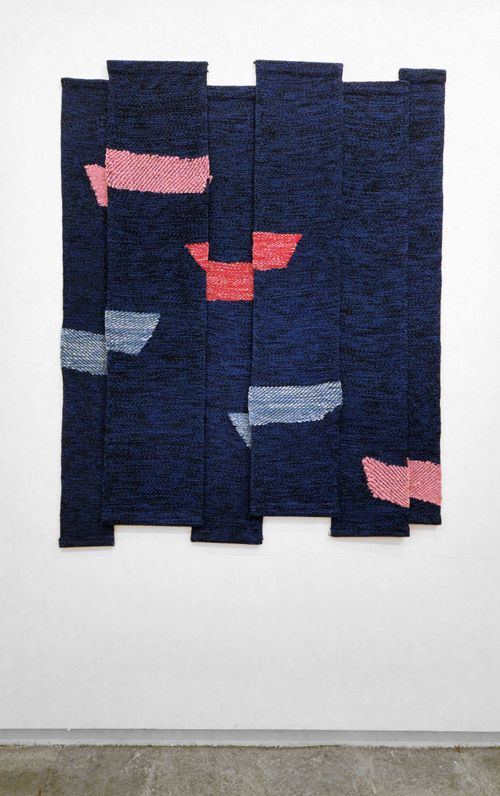
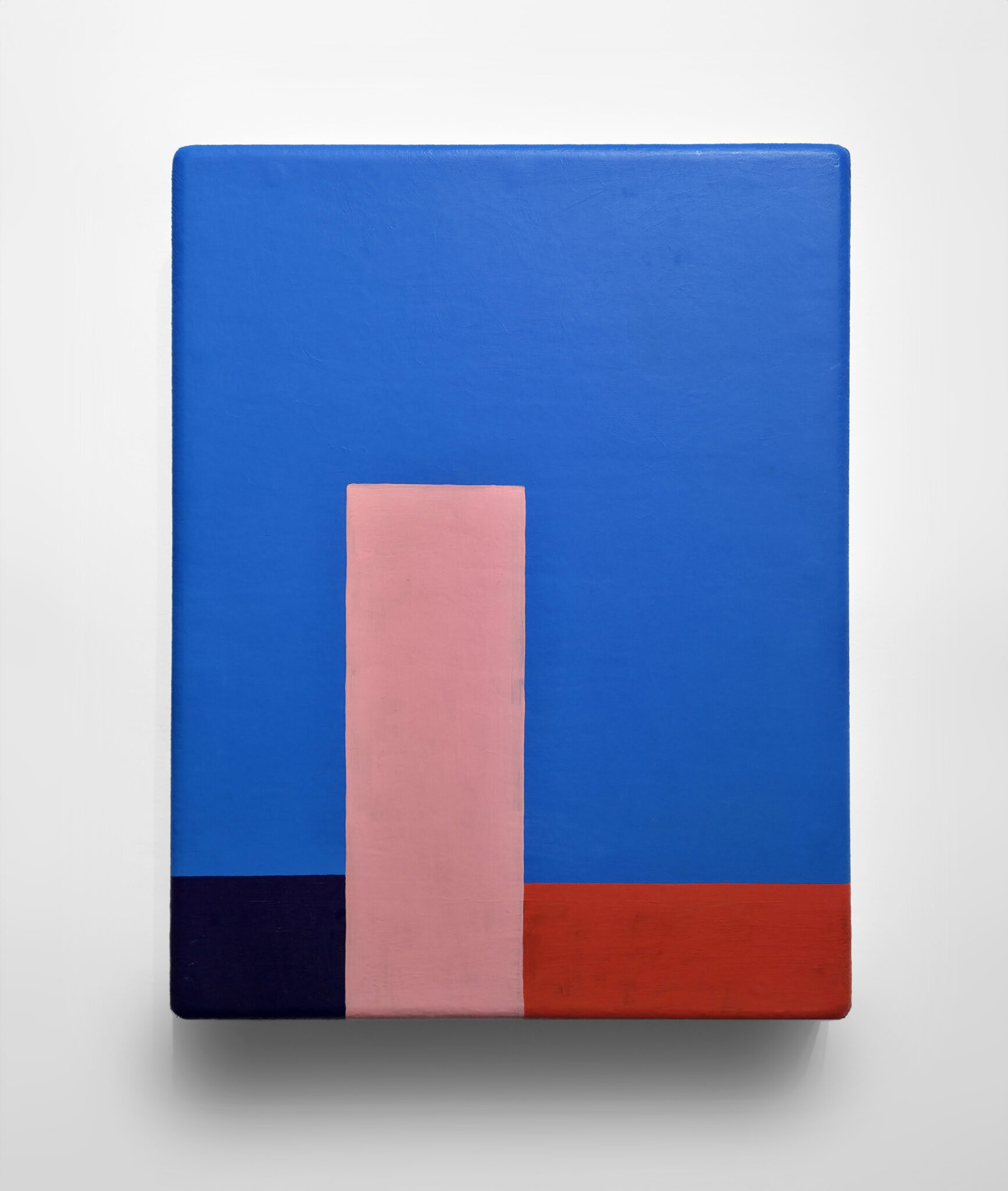
The Tenerife-born artist Luis Palmero paints in this way, as if reciting a Te Deum, a whispered litany to which one returns as a spiritual reverberation. Yet he does so from a position of the most aseptic atheism. And that is where his postmodern bias lies. Because what drives him is practice – ‘making paintings’. And transforming all his work into a pictorial, metalinguistic experience. For this reason, he doesn’t paint landscapes, but instead transforms any surface into a topography of colour. Where the exhibition space joins in to draw the eye, and his paintings and tapestries – or his collages – form a plane that engages in dialogue with another plane which lies upon, hovers over, floats above or is anchored to yet another plane. Where everything becomes an anchor, a territory conquered by the mark – a mark that is at times utterly flat, and at others the very materiality of the ‘coloured thing’, reduced to a smoothed-out blob, laminated in layers … once again.
And this is where the rhythm is to be found (the tempo of inner silence), which I consider to be similar or parallel to the logic of spiritual meditation that resembles prayer. A ritual that has been maintained over time, sustained just as a virtuoso violinist holds a note, until his tense fingers can hold it no longer. Maintaining the pictorial tension as far as his hand can reach, I consider many of Luis’s works to be anthropometric, linked to his slender figure stretched out in the creative space of his studio, or focused on the juxtaposition of media that, layer by layer, sustain his light touch transmuted into chromatic effects. As mere parts, these may reveal absolutely nothing to us, but when brought together by the artist’s skill, they transform into islands, mountains, boats, barges, waves, foam, sandstone, haze and sun.
Palmero realises these visions geometrically as a fractal, expansive tantra , repeated in crescendo towards a poetics of space that we might well define as reminiscent, akin to memory, like when we close our eyes and try to recall a landscape through its scents, as if he were presenting his work as an idiom that becomes abstract whilst being encoded as a language of its own. The authenticity of this artist lies in the charm of his luminosity, in his opaque, subtropical brilliance; where his entire visual narrative unfolds as a model for piecing together fragments of a memory distilled into the way a child licks an ice cream as it melts by the seaside. For there is something of the coastal and insular in his work that beats like a sign, something of a sensoriality saturated with splendour and joy, a happy encounter, a chance discovery or a light-hearted jest, without weight or gravity. Even when it sometimes takes on a sculptural form, made voluminous, a naive quality endures within it like an unwritten rule, because in his work no narrative is possible; there is only poetry, poetic mystery, just as there is in every Te Deum recited.